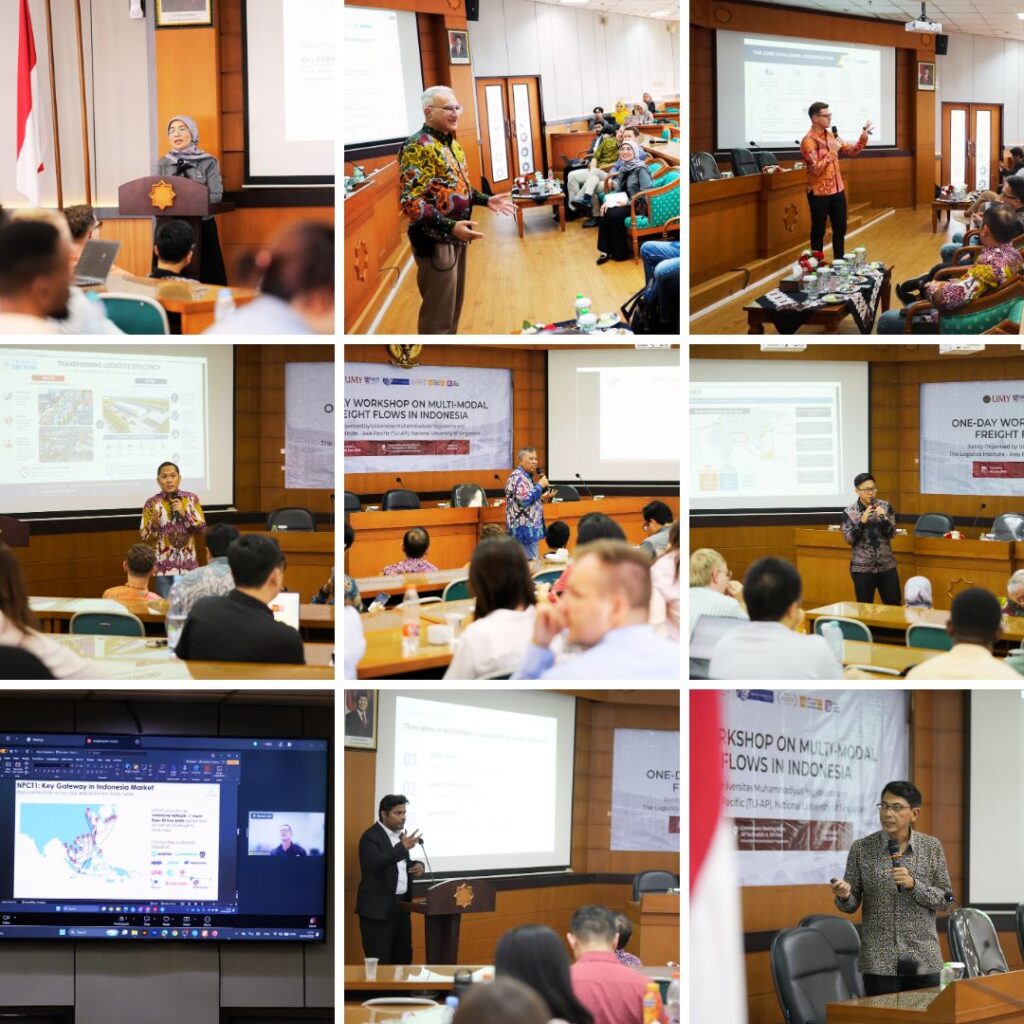
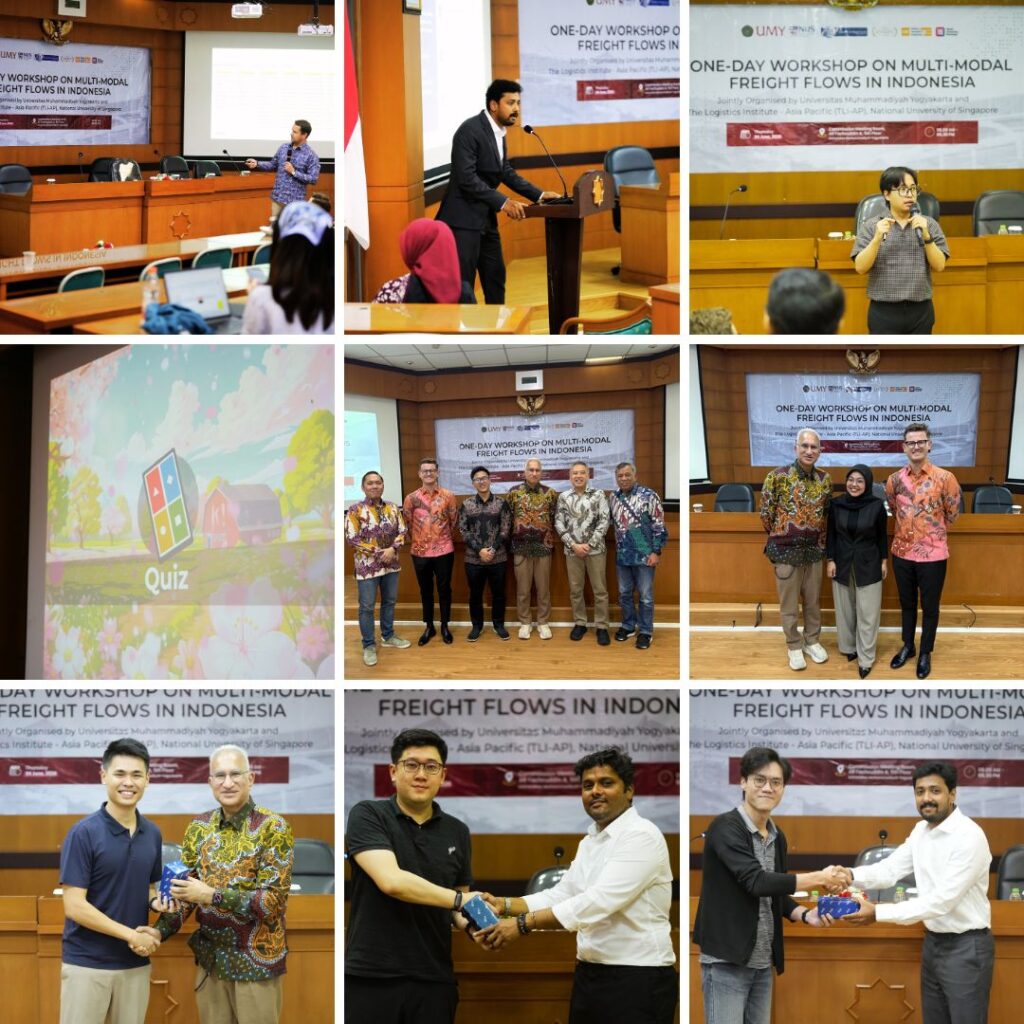
Facilitated by Dr. Giuseppe Timperio of NUS-TLIAP
Moving freight from point A to point B is far more complex than it may appear. Indonesia exemplifies this challenge: an archipelago of more than 17,000 islands, with industry clusters and population concentrated on Java, alongside highly imbalanced trade flows across regions. Navigating this intricate web of connectivity and evaluating the many modal transport options is no simple task.
Against this backdrop, The Logistics Institute – Asia Pacific and Universitas Muhammadiyah Yogyakarta convened scholars from Indonesia, Singapore, and Austria, together with senior industry leaders, for a one-day workshop on multimodal freight flows in Indonesia. The workshop was facilitated by Dr. Giuseppe Timperio of NUS-TLIAP, who guided discussions on the opportunities and challenges of strengthening freight connectivity across Indonesia’s diverse transport landscape.
The workshop featured a distinguished lineup of speakers who contributed valuable perspectives to the discussion. Ronald Nugroho (Cikarang Dry Port) highlighted the role of dry port terminals in easing congestion at coastal ports. Dr. Nofrisel, SE, MM, CSLP, ESLog (PT Sembada Bina Pratama/Asosiasi Logistik Indonesia) advocated for a road-to-rail modal shift on Java. Adithya Prabowo (Samudera Indonesia) explored the opportunities presented by short-sea shipping, a mode that remains underutilized despite Indonesia’s unique geography. Seng Lee Goh (PT New Priok Container Terminal One – NPCT1) emphasized that the effectiveness of a seaport depends greatly on its inland connectivity. Shanmugam Thangavelu (Accenture) provided a global cargo perspective, underscoring the growing importance of data in shaping Indonesia’s logistics future. Prof. Markus Gerschberger (Supply Chain Intelligence Institute Austria – ASCII) shared insights into global freight trends, while Prof. Kuncoro Harto Widodo (Universitas Gadjah Mada) brought the discussion back to the realities of Indonesia’s logistics landscape. Dhanendrakumar Gunasekaran (Value Allies Software Pvt Ltd) demonstrated how technology integration can create value across supply chains, and Dr. Thomy S (Universitas Muhammadiyah Malang) highlighted how cost reduction and emissions reduction can be pursued simultaneously.
Special appreciation goes to Dr. dr. Supriyatiningsih Wenang and Dr. Robert de Souza for their leadership and commitment in bringing the workshop together. Thanks are also due to Universitas Muhammadiyah Yogyakarta, particularly Dede Muniroh, as well as the teams at The Logistics Institute – Asia Pacific for making this collaboration possible.
The consensus was clear: one day was not enough. The conversations initiated during the workshop have laid the groundwork for future collaboration and continued exploration of Indonesia’s freight and logistics challenges.
Indonesia is not alone in facing these complexities. Every ASEAN country grapples with its own version of the logistics puzzle, and the way Indonesia addresses these challenges will have implications for the broader region.
Photo credit: Dr. Giuseppe Timperio (NUS-TLIAP).